A plasma bra that responds to touch. Underwear that sparks with electricity. A glass chainmail dress made from 5,000 handmade rings.
Beyond the spectacle of Istituto Marangoni London graduate Liana Chan (@lianachan___, @liana.c____)’s collection Apotheosis of Me lies a personal story of Catholic-school upbringing, the body, and her fascination with electricity and sparks. Inside her canalside London studio, A2Z met Liana Chan to talk about the experiences, materials and desires that shaped Apotheosis of Me.
The collection begins with the idea of the “good girl.” Who is the good girl to you, and what are the rules she is expected to follow?
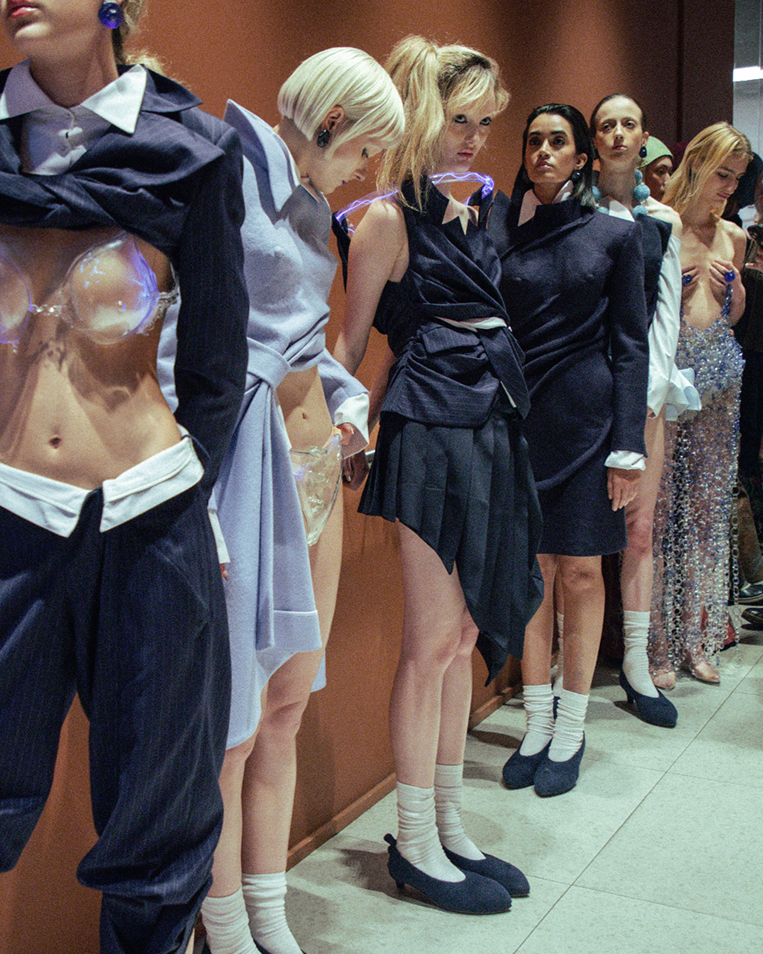
The collection begins by introducing an imposed identity: the “good girl.” Growing up in a Catholic girls’ school, I was taught to embody discipline, modesty, and virtue like a “well-educated young lady”. Rather than rejecting these expectations outright, I became interested in how rebellion can exist from within the system itself.
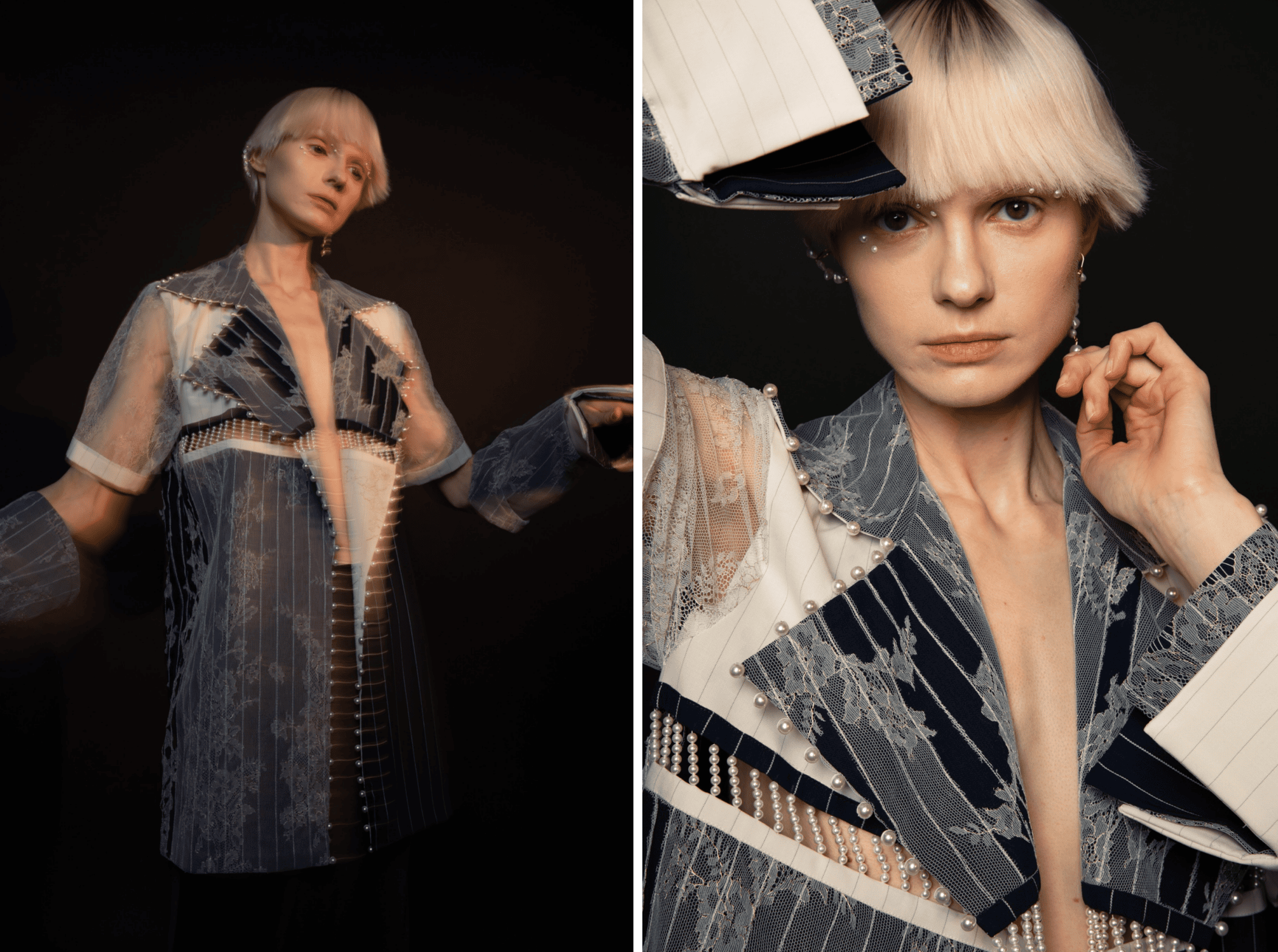
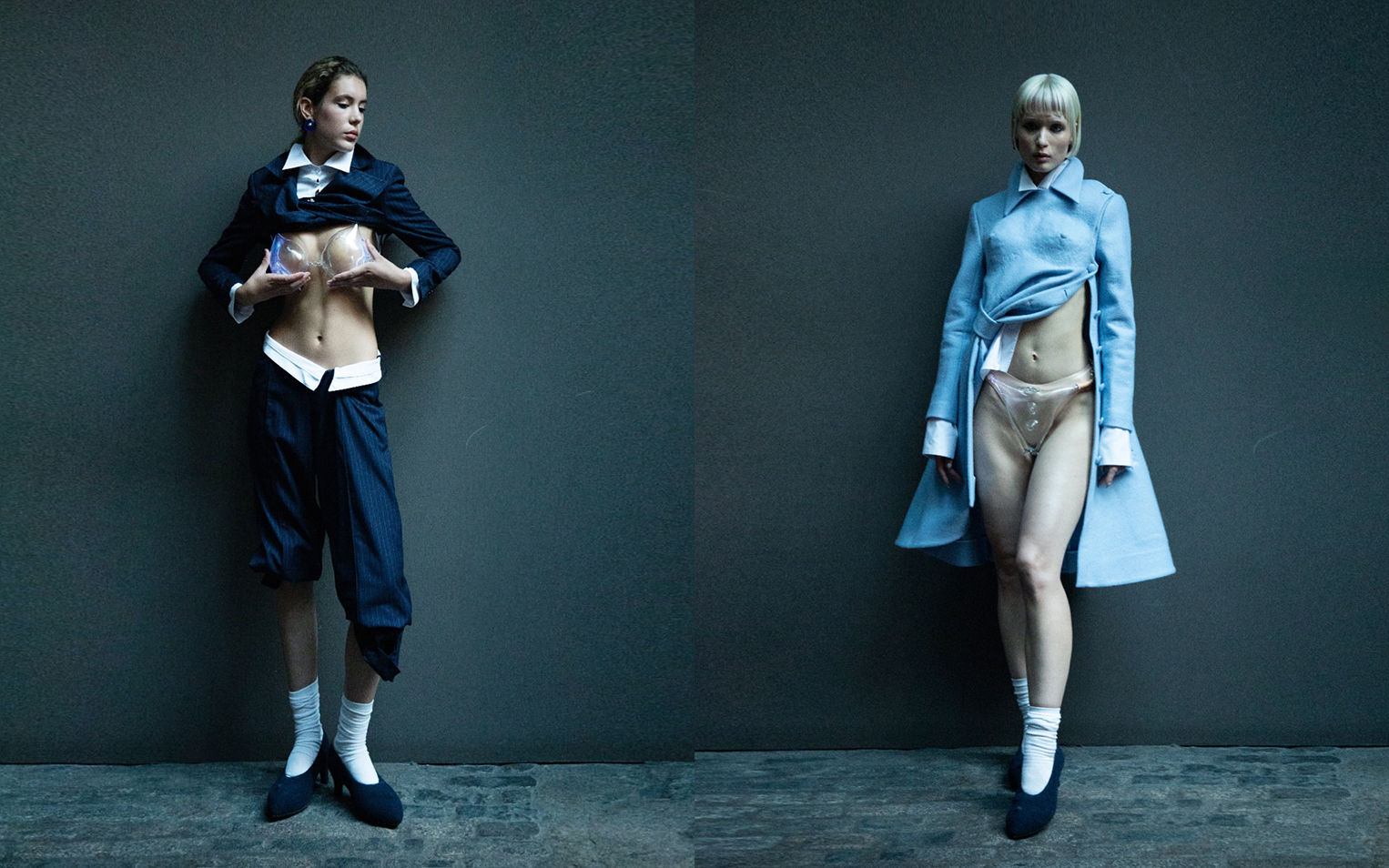
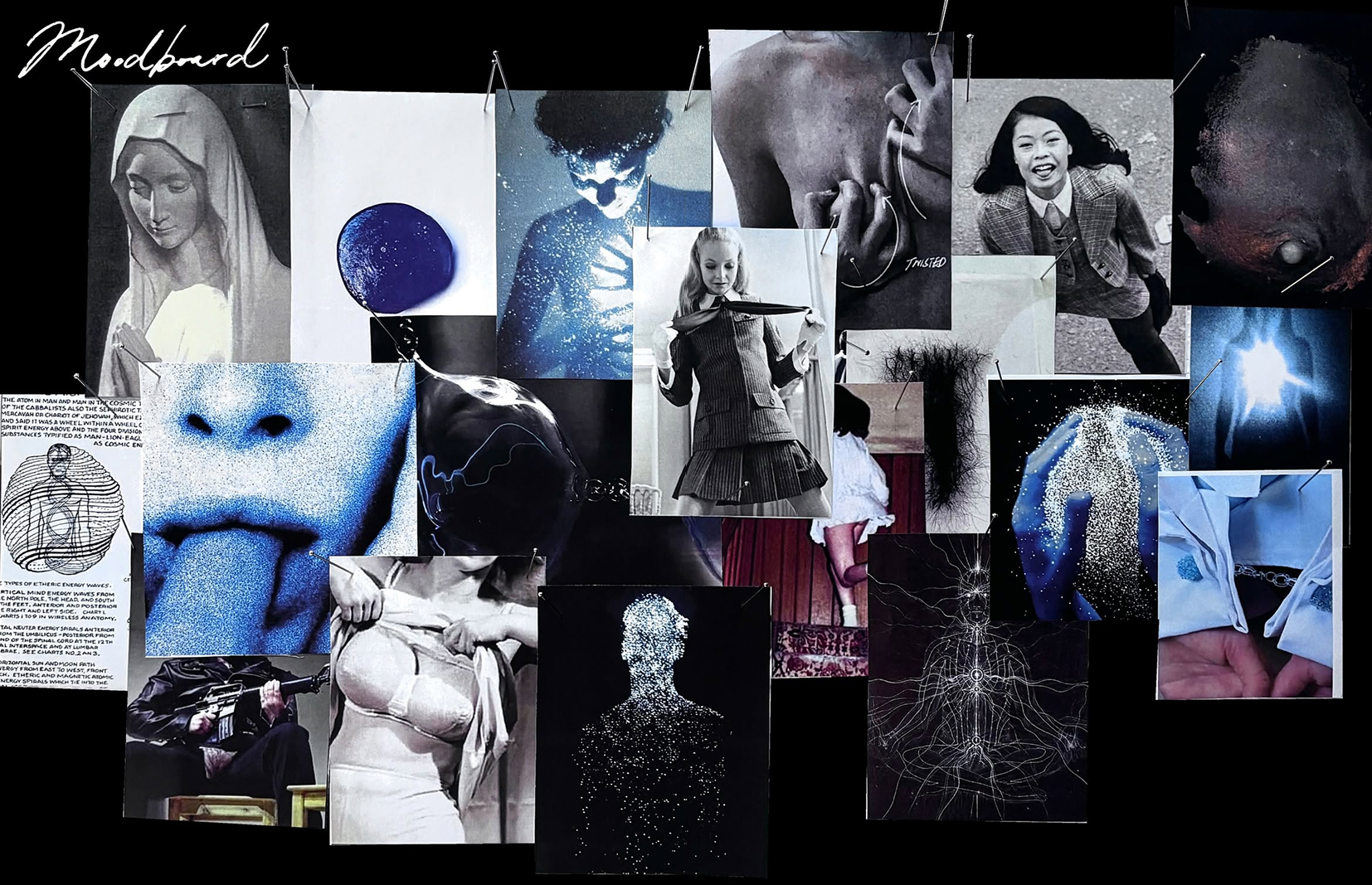
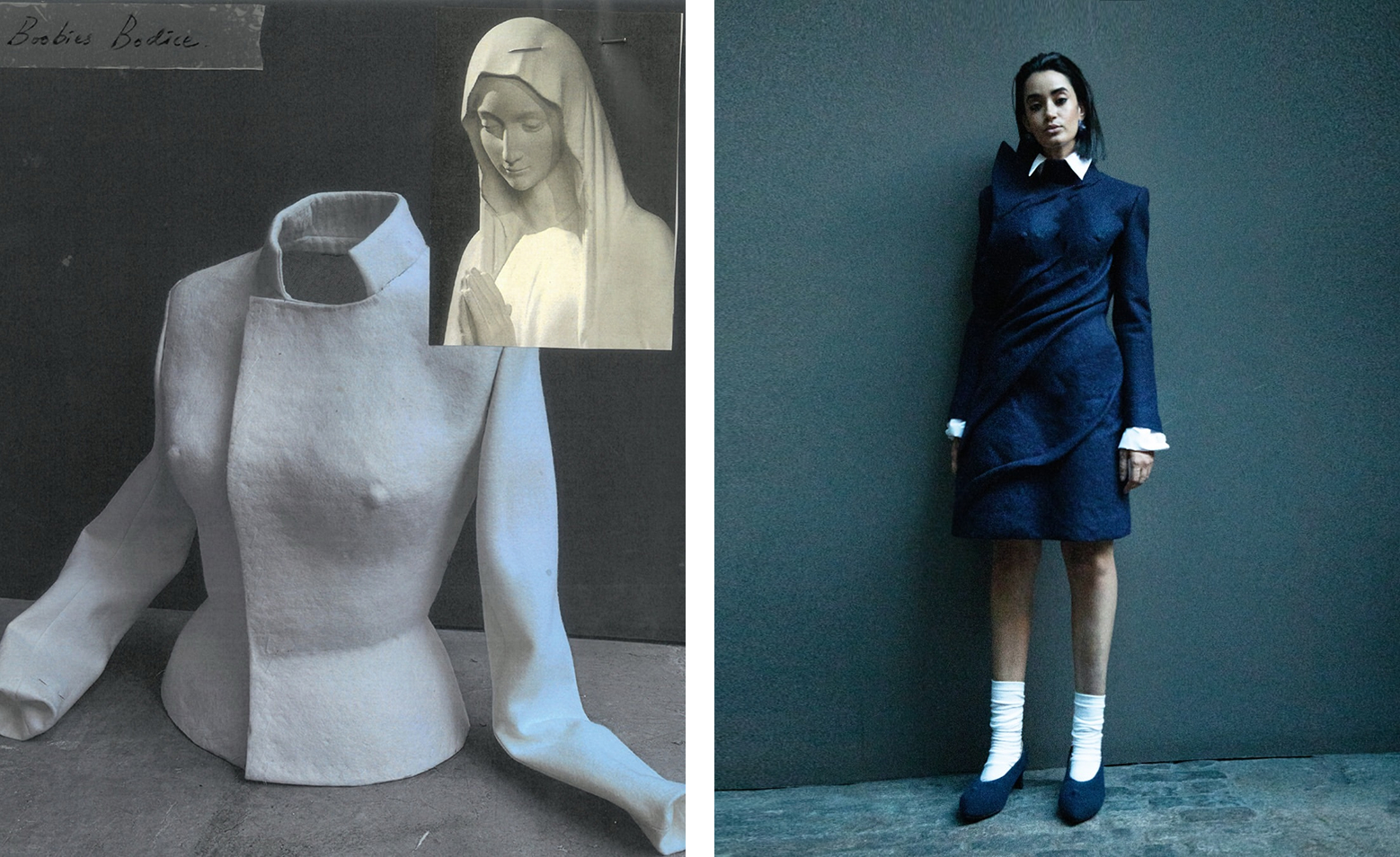
The first look is inspired by sculptural representations of the Virgin Mary, a figure that was constantly presented to us as a role model. I chose to follow the rules, but in my own way. Using traditional tailoring techniques associated with discipline and institutional dress, I constructed a garment that appears obedient and restrained at first glance.
Yet beneath the surface, the body refuses to disappear. Through moulded tailoring, sculpted boobies and bodily contours emerge underneath the fabric. The female form is covered, but never concealed. The bumps, curves, and presence of the body become visible through the restraint itself.
This paradox became a key principle of the collection: I reveal the body by covering it. By referencing the Virgin Mary and the language of tailoring, I explore the tension between virtue and desire, obedience and self-expression. The garment appears to conform, but quietly resists. It follows the rules while simultaneously questioning them. In this sense, rebellion is not found outside the system, but hidden within its very structure.
How has your upbringing shaped the way you approach ideas of the body, femininity and sexuality in your work?
Growing up, there were many expectations placed upon me—by school, family, religion, and society. I was constantly encouraged to become a certain type of person: disciplined, modest, polite, and well-behaved. As a result, I often found myself questioning whether my choices were truly my own, or simply reflections of what others expected me to be. This questioning became central to how I approach the body, femininity, and desire in my work. Before we are daughters, students, women, or professionals, I believe we are simply energy organised into a physical body. To me, that energetic presence is the most delicate and precious part of who we are, yet it is often buried beneath expectations, obligations, and social roles.
The timing of this collection also feels significant. Graduation marks the end of one chapter and the uncertainty of another. Many fashion students spend years developing a final collection only to spend the rest of their careers helping realise someone else's vision. For some, a graduate collection may be the last collection they ever create entirely for themselves.
That thought stayed with me throughout the process. I kept asking myself: What if there is no tomorrow? What if this is the last collection I ever make?
With that understanding, I felt a responsibility to be completely honest. Rather than creating what I thought people wanted to see, I wanted to create something that reflected what I genuinely believed in. This collection became an act of self-authorship—a declaration that, at least for this moment, I would choose my own curiosity, my own desires, and my own light. If the project speaks about self-actualisation, it is because I was trying to practise it myself.
Why did you choose glass, and what was the process of turning your initial idea into the final piece? Were there many experiments or changes along the way?
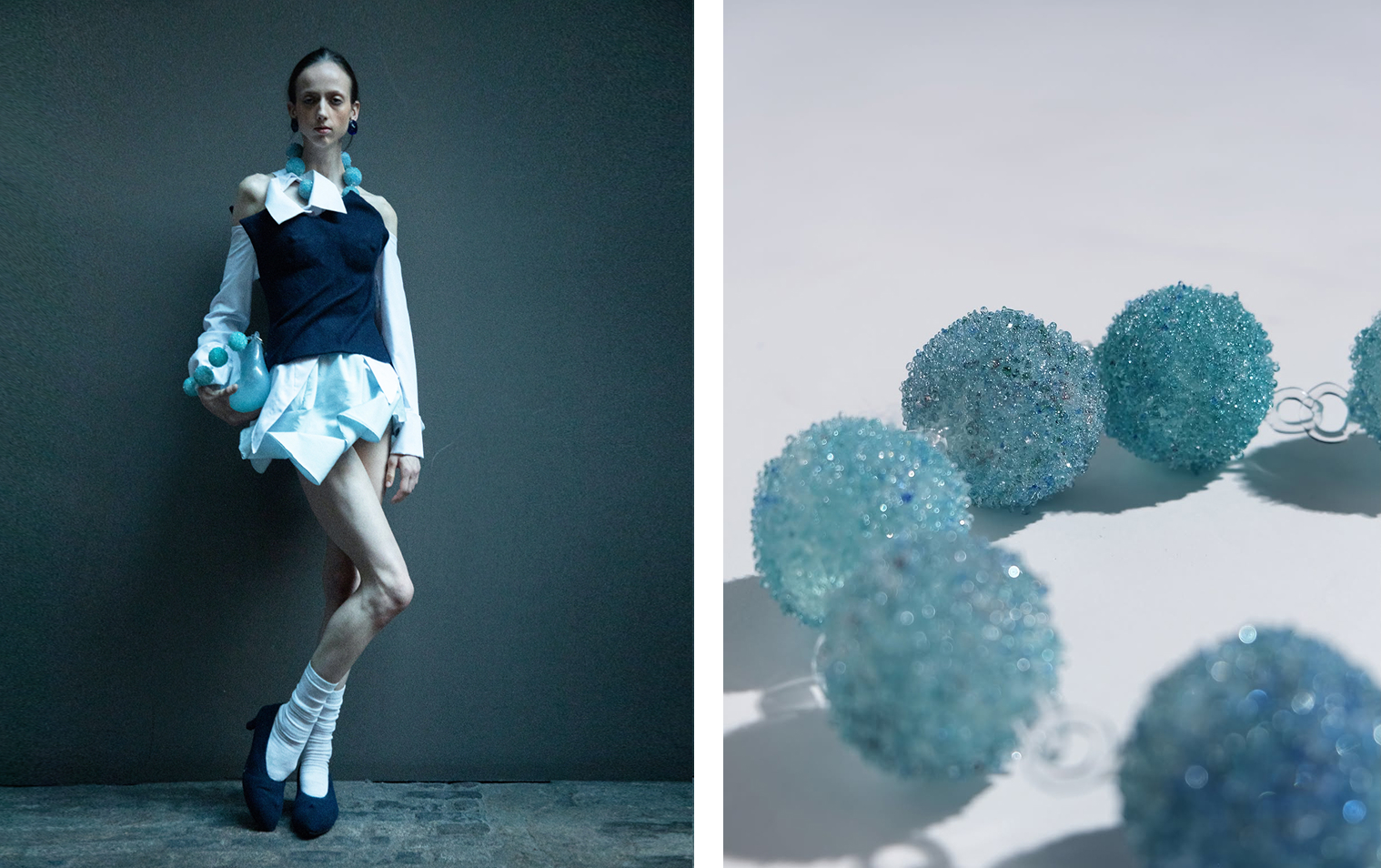
I chose glass because it embodies many of the contradictions I was exploring throughout the collection. It is fragile yet durable, transparent yet present, and constantly transforms between states. On an atomic level, glass is neither perfectly ordered like a crystal nor completely random. Its structure exists somewhere in between, which resonated with my understanding of identity as something that is never fixed, but always becoming.
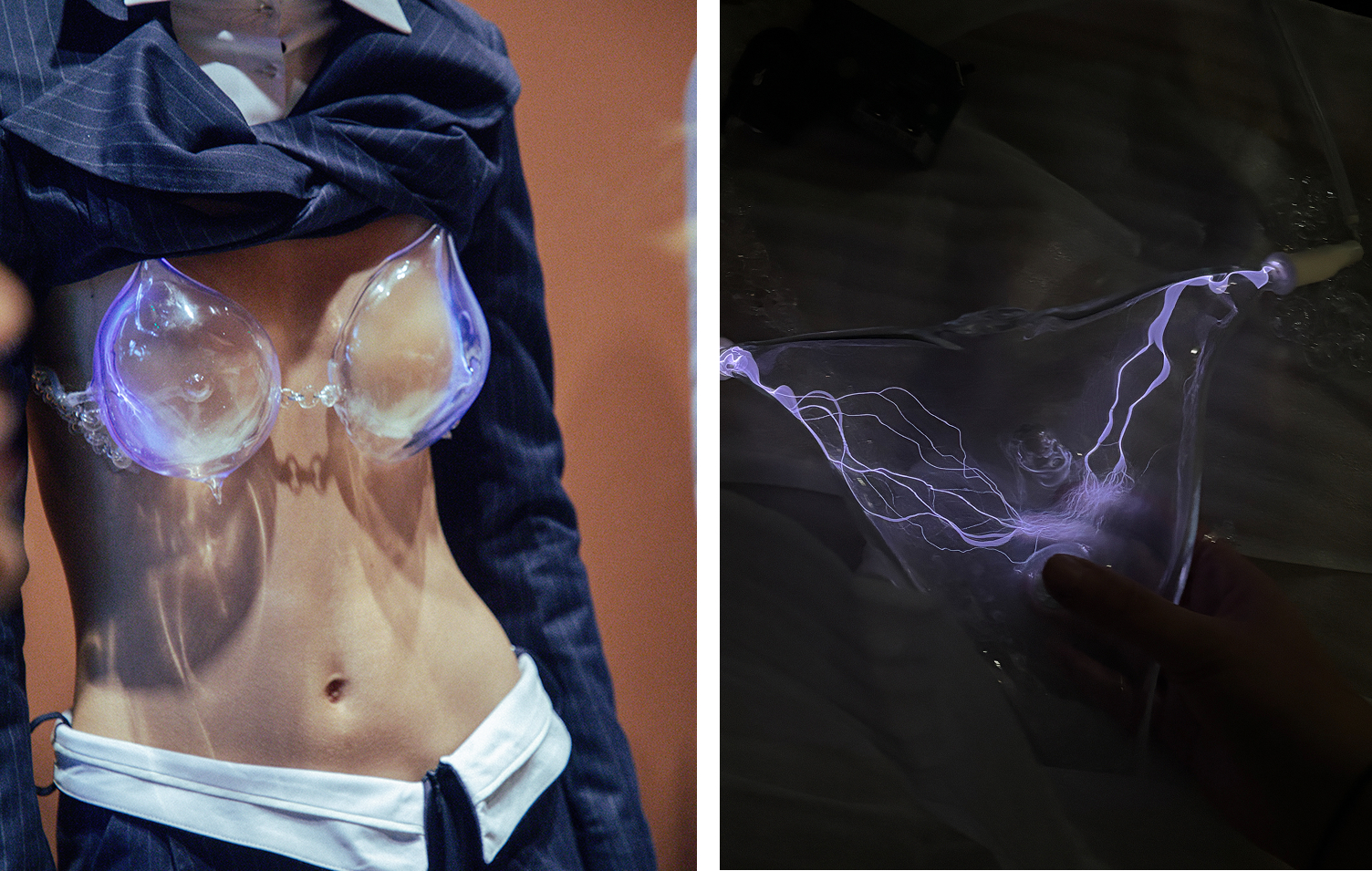
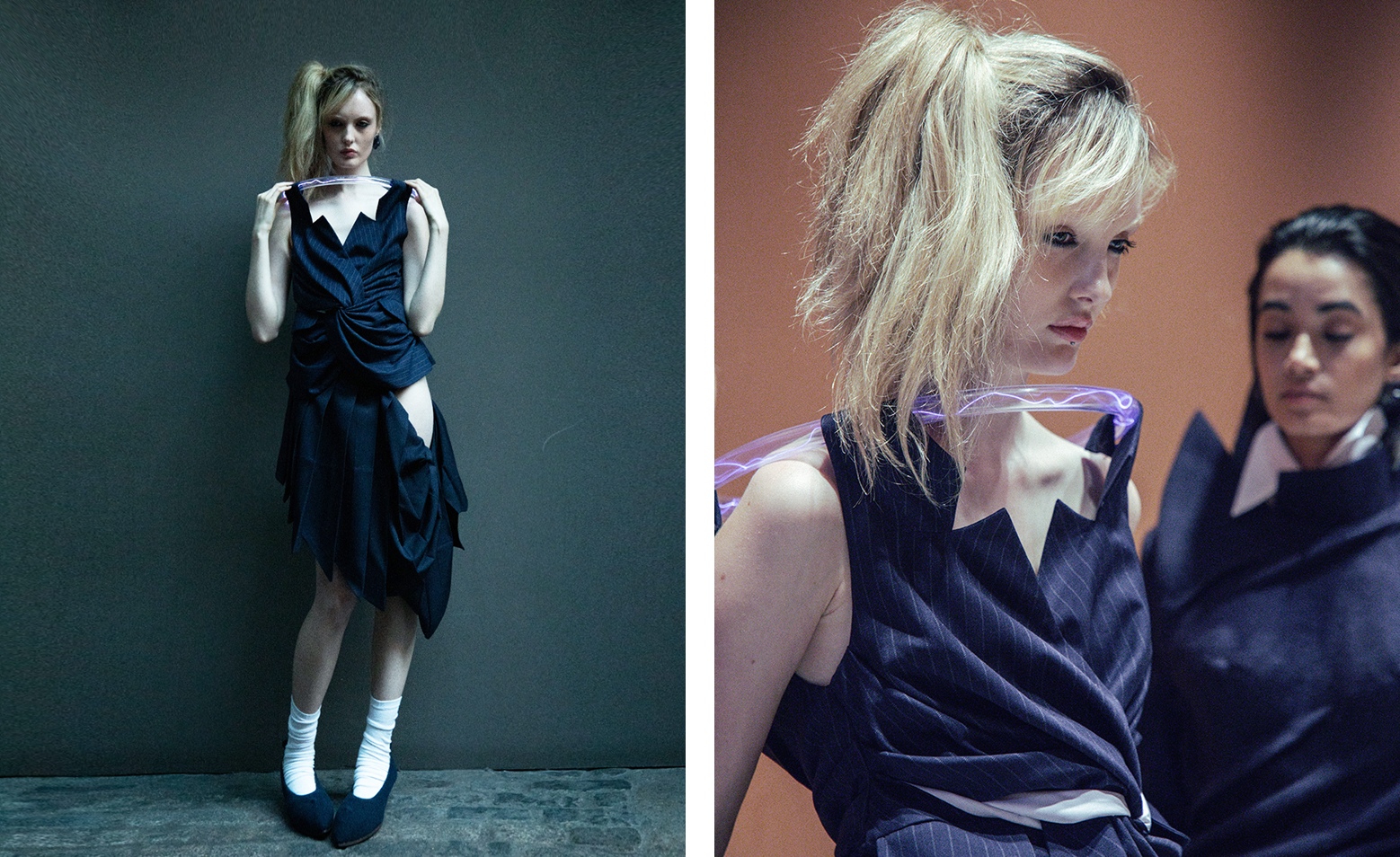
I was also fascinated by the way glass interacts with light. Glass can transmit, reflect, distort, and contain light, making the invisible visible. This became particularly important when I began researching plasma. By sealing xenon gas inside hand-blown glass forms, light could respond directly to touch and movement. I became interested in the idea that the plasma follows the body in the same way our desires guide us towards who we are becoming.
The process involved a year of experimentation between London and Jingdezhen, China. I learnt glass blowing and plasma techniques, developed wearable prototypes, and tested different ways of integrating glass into the body. The final collection includes hand-blown plasma sculptures, cast glass nipple rings moulded from my own body, and a glass chainmail dress made from over 5,000 handmade rings.
For me, glass became more than a material. It became a way to visualise identity as energetic presence—something delicate, luminous, and constantly in motion.
Breasts keep appearing throughout the collection. Sometimes hidden inside tailoring, sometimes sculpted into the garment, and eventually completely exposed in glass. Why did the breast become such an important recurring form for you?
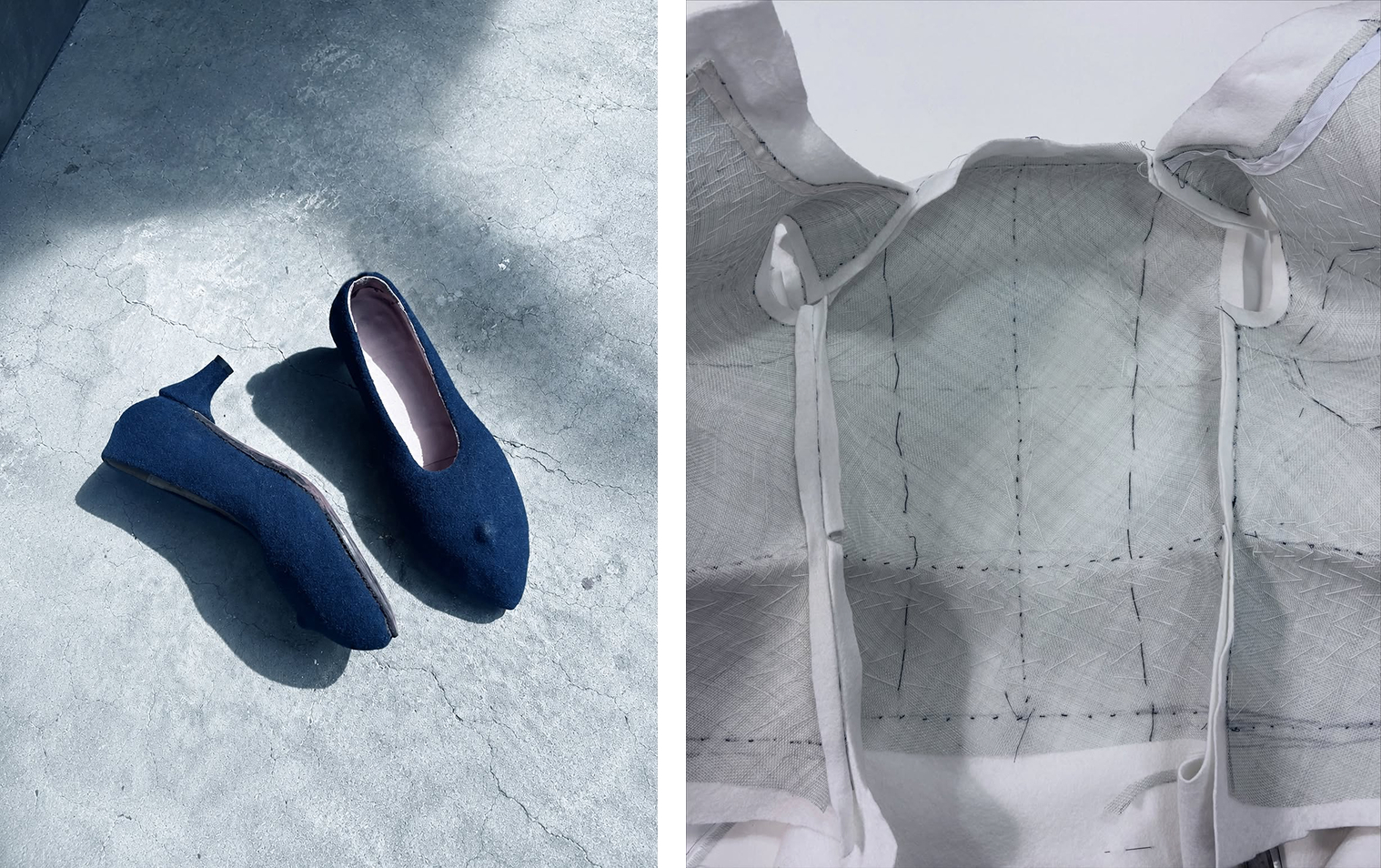
Breasts became a recurring form in the collection because they represent a part of the self that was constantly present, yet often hidden. Growing up in a Catholic girls' school, there were endless rules and opinions about how breasts should exist. A visible bra strap, a black bra beneath a white shirt, or the outline of the body under a uniform could all be considered inappropriate or immodest. At the same time, many girls felt uncomfortable with their changing bodies and would hide beneath oversized wool vests or sweaters.
Yet my memories were not defined only by restraint. There was also humour, curiosity, and intimacy between friends. I remember how girls would jokingly grab or touch each other's boobs, not in a sexual way, but as part of a shared experience of growing up together. It was playful, immature, and strangely ordinary. Looking back, I see these moments as subtle acts of resistance against the modesty and seriousness that were constantly imposed upon us.
What fascinated me was that the breast sat at the intersection of discipline and self-discovery. It was never simply a body part; it became a site where shame, confidence, curiosity, desire, and identity all collided.
Throughout the collection, the breast transforms alongside the narrative. It first appears hidden beneath sculptural tailoring inspired by the Virgin Mary, where I reveal the body through covering it. Later, it becomes a hand-blown plasma bra, transforming the breast into a vessel of energetic presence, where light follows touch as a metaphor for following one's desires. Finally, it is distilled into cast glass nipple rings moulded directly from my own body, becoming the structural foundation of the final glass chainmail sculpture.
For me, the breast became a symbol of the self that institutions attempt to regulate but can never fully suppress. As the collection progresses, what was once hidden gradually becomes visible, moving from restraint towards self-realisation.
Some pieces are literally moulded from your own body. Did making the work from your own body change your relationship with the project?
As a fashion designer, using your own body as a reference is often a natural part of the design process. We drape on ourselves, fit garments on ourselves, and use our bodies to understand proportion and form. So when I decided that breasts and nipples would become recurring elements throughout the collection, it felt instinctive to use my own body as the starting point.
As the project developed, however, the decision became more personal. The collection is rooted in my own experiences of growing up in a Catholic girls' school and the journey from obedience towards self-actualisation. Casting my own body felt like a way of embedding a piece of myself into the work. The glass nipple rings are not there for shock value; they function almost like a self-portrait, preserving a trace of my presence within the collection. I've always been interested in world-building. For me, creating is the process of taking something that exists only in imagination and making it physically real. This collection began as an imagined version of myself—a person who had fully embraced her desires, curiosity, and inner light. By casting my body into glass, I was literally placing a piece of myself into that imagined world and bringing it into reality.
I believe imagination has the power to transform how we experience the world. Throughout my life, it has often been the vision of a better self that has guided me forward, like a small light in the distance. The collection became a way of materialising that belief. It is built from memories, desires, and possibilities, transformed into something tangible that can be shared with others. In a way, each piece is an attempt to bring a little more light into the world—not by providing answers, but by encouraging people to imagine who they could become, and to follow that possibility.
If the first look represents the “good girl,” who is the woman we meet in the final look?
If the first look represents the “good girl,” then the woman we meet in the final look exists beyond that identity altogether.
The collection begins with a body shaped by expectations. Inspired by the Virgin Mary, the first look embodies discipline, modesty, and virtue. The body is covered, restrained, and carefully negotiated through tailoring. Although sculpted breasts emerge beneath the surface, they remain contained within the language of institutional dress. By the final look, the notion of uniform, imposed identity, and social expectation has been completely stripped away. What remains is not a student, a daughter, or a "good girl," but an energetic presence.
Constructed from over 5,000 individually handmade glass rings linked together over the course of a year, the dress exists as a woven field of transparent structures suspended from cast glass nipple rings moulded directly from my own body. The rings resemble atomic particles, sparks, or points of light, coming together to form a living structure. Rather than concealing the body, the garment suggests that beneath every role we inherit lies something more fundamental: a collection of energy, memories, desires, and experiences temporarily organised into a physical form.
As I reached Apotheosis Dreaming, the body is no longer defined by what it should be. Light becomes a metaphor for self-realisation, and the glass chainmail becomes a manifestation of the self in its most elemental state—an existence no longer shaped by expectation, but illuminated from within.
As a young designer entering the industry now, what feels most exciting to you, and what feels most difficult?
The most exciting part of entering the industry is that it finally feels like stepping into the real world. As a student, your work is often seen within the context of education, but once you graduate, the work belongs to the public. People begin to form their own opinions, interpretations, and reactions. What interests me most is observing those reactions. I have always believed that once a piece of work is released, it no longer belongs entirely to the creator. People bring their own experiences, beliefs, and memories to it. Whether they love it, hate it, are confused by it, or feel inspired by it, I find that incredibly fascinating. Being able to share a thought with the world and observe the different conversations and emotions it generates feels like watching a chemical reaction unfold in real time.
The most difficult part is probably the uncertainty. Like many fashion graduates, I spent years saving money while studying to fund this collection. Everything you see is the result of that investment—financially, emotionally, and physically. Now that the collection is finished, there is a new question: what comes next?
There is the reality of finding paid work, building a career, and sustaining a creative practice at the same time. I think that struggle is something almost everyone entering the industry experiences. You have to balance survival with ambition, commercial work with personal work, and immediate responsibilities with long-term dreams.
But I also find that uncertainty exciting. For the first time, there is no syllabus, no project brief, and no clear path ahead. I am interested in seeing where my curiosity, skills, and opportunities will take me next while continuing to create work that feels honest to who I am.