Can we repair our ecological disaster? Yuchen Liu, an emerging fashion designer, uses fashion to express the emotional powerlessness that people may feel in the face of the climate crisis, presenting the garment collection Solastalgia. This concept, combining solace and nostalgia, describes the emotional distress caused by environmental change while remaining in one’s home environment.

This collection centres on a series of long dresses, with the colour scheme focused on low-saturation shades of blue, black and white. This overall colour approach directs the visual focus back to the silhouettes and the fabrics themselves, emphasising the layered interplay between different materials. The garments create light, flowing lines when worn, maintaining a clear and stable sense of structure. The fabric unfolds in motion with natural grace, providing the silhouette with measured support and volume, lending the overall look a sculptural three-dimensionality.
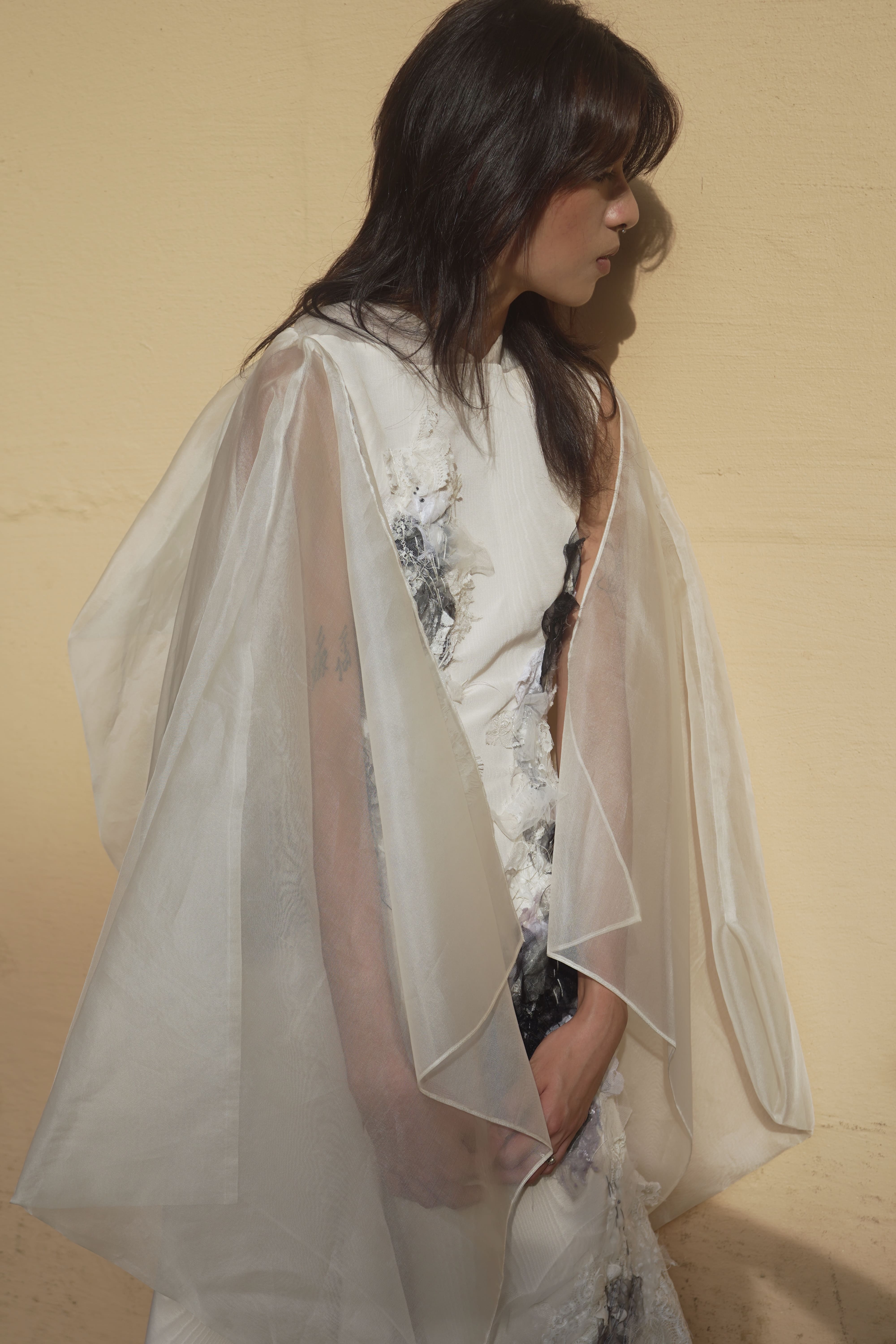
Using “solastalgia” as a metaphor, Liu translates the uneasy feelings towards climate change into material, construction, and surface detail. She works with deadstock, often mended with the thinnest remnants, keeping their imperfections visible. Embroidery is applied in scattered sections across the surface of the gowns, appearing more like fragments than fixed patterns.

Stitching, patching, and layering remain visible throughout, and this is a key part of Liu’s design. Her design technique reflects Boro textiles, a Japanese practice dating back to the Edo period (1603–1868), which extends the life of garments by stitching together small pieces of fabric. She adapts this technique by using a heat gun and iron to modify the fabric before stitching. This process creates an uneven surface, which produces an effect that suggests disappearing glaciers, reflected in cracked, layered, and irregular surfaces resembling melting ice and fragmentation.
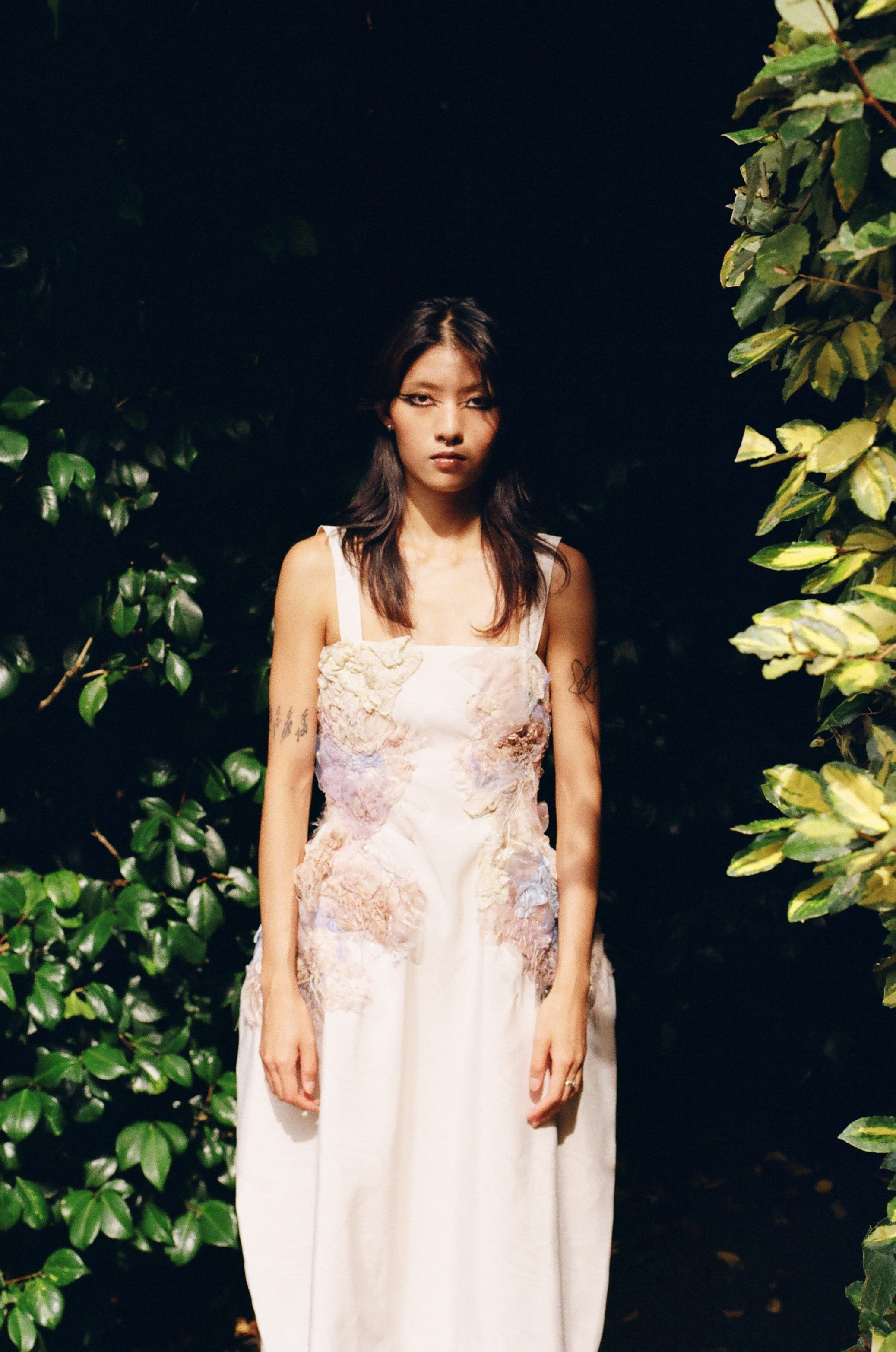
Sustainability is the core of Liu’s design. he explores zero-waste pattern cutting on the stand, starting from rectangular pieces of fabric as a whole, and then uses folding and pleating to build up volume. This construction method originates from earlier garment traditions developed under material constraints. Garments such as the kimono and traditional Chinese trousers are made of geometric shapes, allowing fabric to be used as a whole with little waste. Inspired by this, Liu works without darts and uses the fabric itself to shape volume, carefully balancing softness and structure.

In terms of the construction of Liu’s garments, she develops sculptural silhouettes that extend outward from the body, with volume created through folding and layering. Some areas remain firm, while others fall away more loosely. The silhouettes contain sharp angles and stretchedproportions, which are inspired by monuments in Socialist Yugoslavia, such as the Kadinjača Memorial Complex, with powerful geometric shapes. The bold geometric forms shift with the body, which gives the garments their own character, a dystopian character in contrast to the natural environment.

In Liu’s Solastalgia, she turns delicate materials into garments with strength through the careful handling of texture, structure, and silhouette. The signs of damaged and repaired fabrics remain visible, demonstrating a tension between fragility and strength, particularly drawing attention to today’s environmental issues.